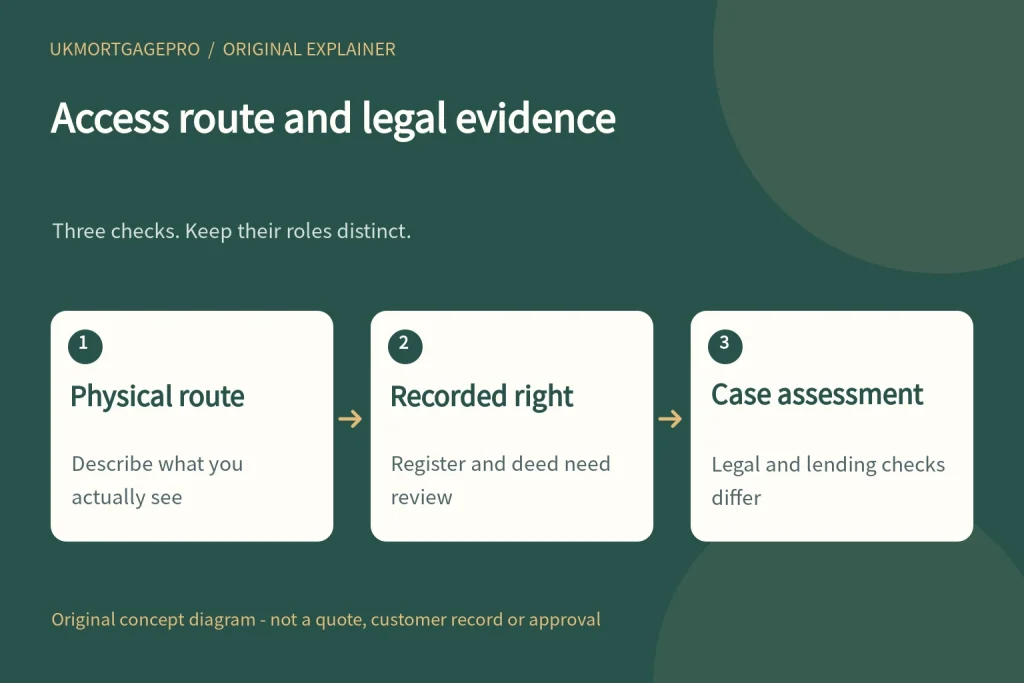
UKMortgagePro original relationship diagram: Physical route / Recorded right / Case assessment. The three checks do not replace one another.
Direct answer: appearance is not the legal evidence
Seeing a track, driveway or access route on a map does not, by itself, confirm the legal right your property has to use it. For an England or Wales property refinance, ask the conveyancer to check the actual register and the documents it refers to. Keep the physical route, the recorded right and the lender’s security assessment as separate questions. This is document-organisation guidance, not a decision about an individual right of way.
Find the relevant entry and the referenced material
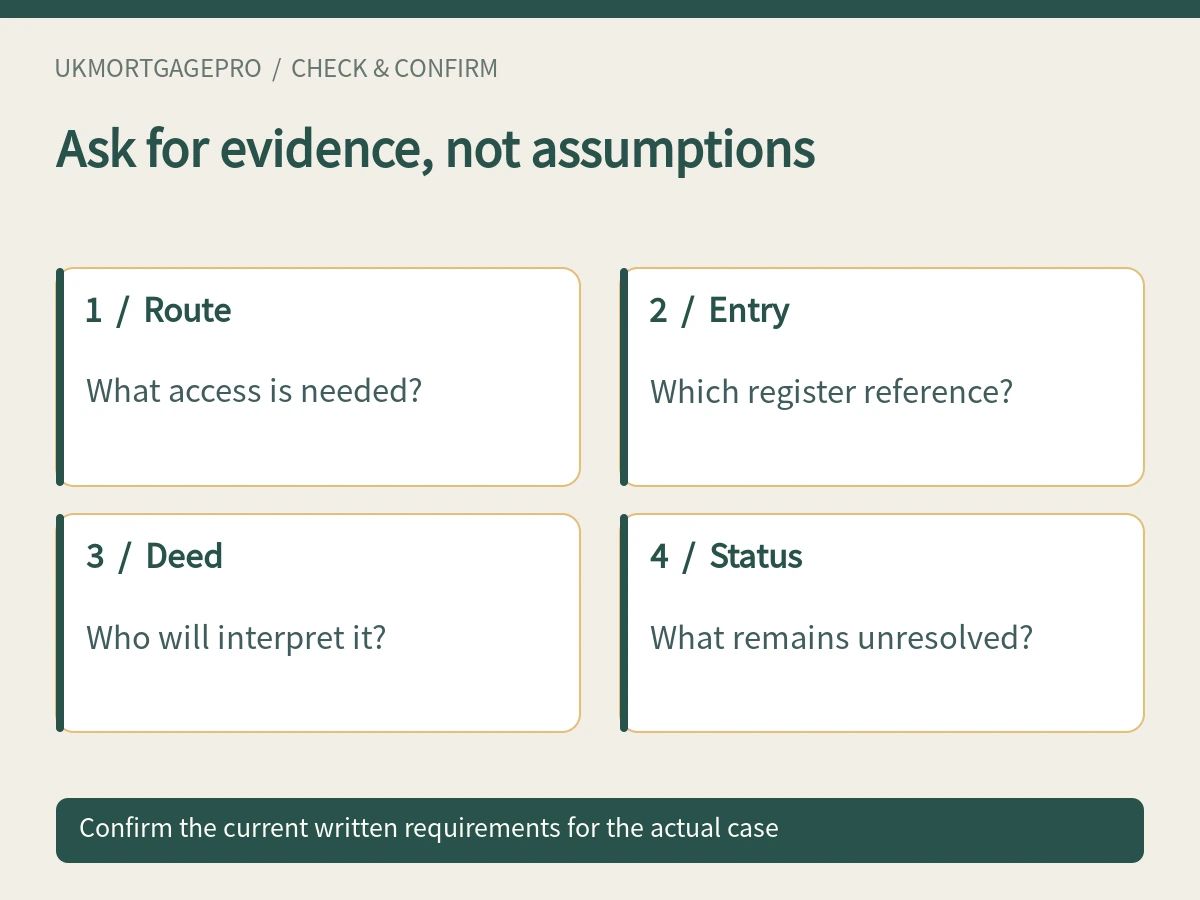
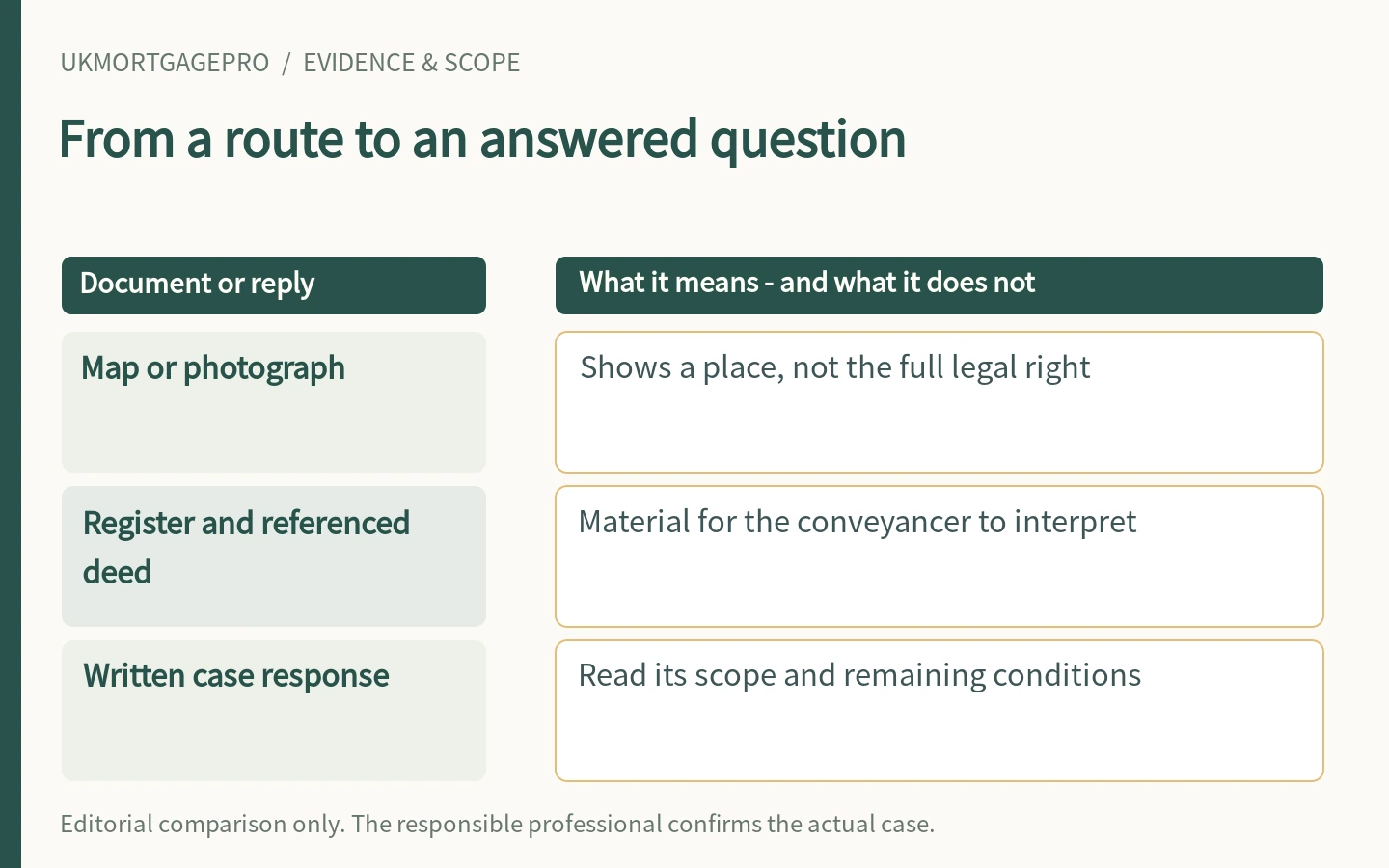
HM Land Registry’s public information guide explains that the register may include easements, such as a right of way. In some cases it instead identifies the documents containing the details. Record the relevant entry and document date, then ask what material the conveyancer needs to review. A brief property summary, a marketing plan or a statement that the route has always been used is not a substitute for that professional interpretation.
Explain the access that your proposal needs
Describe the present access and what you propose to do, without asserting that a different or broader use is legally permitted. Ask the legal professional whether the actual documentation addresses the question. If the route or land referred to is unclear, leave it as an unresolved matter. This article does not infer rights for pedestrians, vehicles, shared areas or future alterations from the mere existence of one entry.
Do not mistake new register wording for a new right
HM Land Registry’s August 2025 explanation describes standardised wording introduced from 15 September 2025. It says the change concerns clarity and consistency, not changes to the application process or evidence requirements, and that existing entries remain legally valid. Different wording between two registers therefore is not, on its own, evidence that one property gained broader rights or that an older entry must be replaced. Use the actual register and deed rather than guessing from the phrase alone.
Separate title interpretation from maintenance and lender questions
If upkeep, costs or another party’s consent matters to your proposal, ask who should explain the relevant documents and whether those issues are within the legal instruction. Separately ask the actual lender or its permitted channel about the security information required for the case. Neither a satisfactory initial valuation nor sending a deed to an adviser guarantees mortgage approval or confirms all access conditions have been met.
Prepare a clear handover before refinance costs are compared
A practical handover identifies the property, register reference, document available, access question and party responsible for answering it. Mark each item received, missing or awaiting interpretation. Ask whether reviewing the referenced documents is covered by the legal quote. No processing time, fee or release date is promised here. Until the open questions are answered, avoid describing access as clear or using expected refinance proceeds to make an irreversible spending commitment.
Make a difference log before requesting an explanation
If a map, register description and a physical route appear inconsistent, list what each source actually says and its date. Do not redraw a legal boundary or expand a right in your own summary. Ask the conveyancer whether a further document or explanation is needed, and keep any answer tied to the particular property and proposed transaction. This provides a clearer handover than describing every access issue as a problem with the mortgage product. It does not establish a dispute, a remedy or the lender’s decision.
Practical checklist
- Record the actual access question and the precise property.
- Ask the conveyancer to review the relevant register entry and deed.
- Do not infer wider rights from a map, physical use or newer wording.
- Confirm the scope of legal work and the lender’s separate requirements.
Questions to clarify
Does the title plan establish every right of way?
Do not assume that it does. Ask which entry and referenced deed establishes the relevant right for the property.
Must an older easement entry be updated to the 2025 wording?
The cited HM Land Registry explanation says existing entries remain legally valid. That is not a reason to change an individual entry without professional advice.
Does providing the deed guarantee refinance?
No. It supplies material for assessment; legal interpretation and lending approval remain separate case-specific matters.
Sources and scope
- HM Land Registry / GOV.UK: Search for land and property information — checked 2026-10-11; page publication/update date: not stated or not established
- HM Land Registry: Easement entries in the register of title — checked 2026-10-11; page publication/update date: 2025-08-27; wording introduced 2025-09-15
Public information and document-organisation guidance only; not personal mortgage, legal, tax, valuation or investment advice, and not lender approval or endorsement. Confirm current case requirements with the responsible professionals.
Related information and consultation
UK property refinance preparation · UK mortgage information · News and practical guides · Arrange a consultation. Enquiry acknowledgement is not mortgage approval.