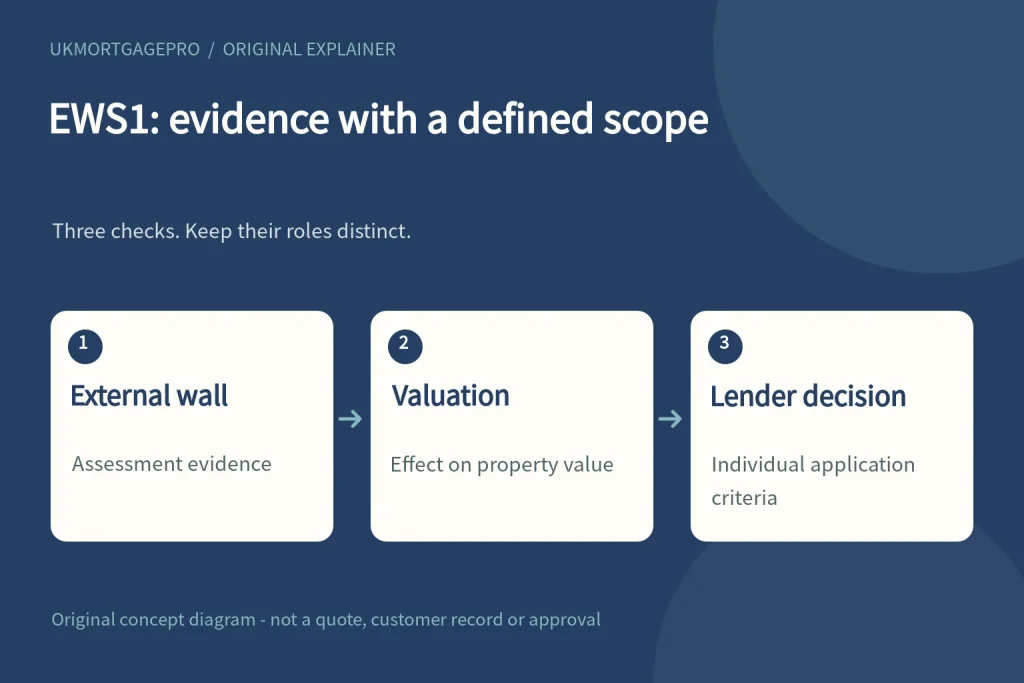
UKMortgagePro original relationship diagram: External wall / Valuation / Lender decision. The three checks do not replace one another.
The short answer: separate the assessment from the decision
An EWS1 form communicates the outcome of an external-wall assessment for a particular purpose within the valuation and lending process. RICS expressly distinguishes it from a life-safety certificate. It does not replace a wider fire-risk assessment, answer every question about the building, or approve your mortgage. Start by identifying the building, the document you actually have and the precise information requested by your lender or valuer. A form supplied by an estate agent is a document to check, not a reason to mark the whole remortgage application complete.
Why the document’s scope matters
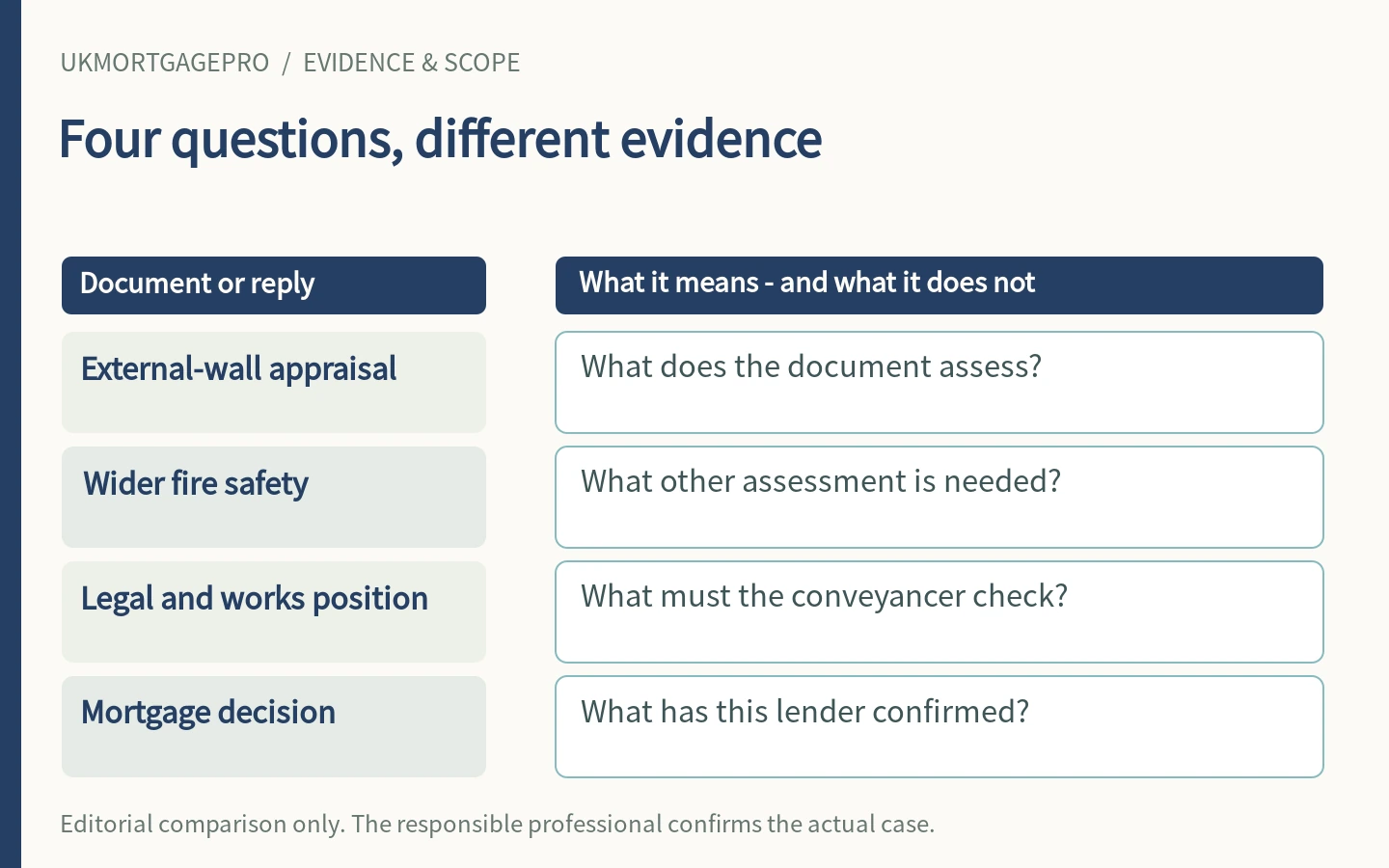
External walls are only one part of a building. Questions about other fire-safety measures, general condition, maintenance, legal title and financing can require different evidence and different professionals. RICS explains that EWS1 is intended to help valuers and lenders understand whether external-wall remediation affects value; it should not be used to determine the overall fire risk of a building. This distinction matters when an owner receives a reassuring summary such as 'the building has a certificate'. Ask which certificate, what it covers, who prepared it and what conclusions it actually records.
Build a document index before interpreting a rating
For an initial discussion, list the property and block to which the form relates, its date, the professional or organisation named, the recorded outcome and any related report or later correspondence. Note whether you have a full document or only a copied page. Ask the building owner or managing agent for the appropriate information rather than editing the form yourself. The valuer, lender and relevant professionals need to consider the actual evidence. This article does not interpret a rating for an individual building or provide a rule that a particular rating always means acceptance or rejection.
Older forms require context, not an automatic conclusion
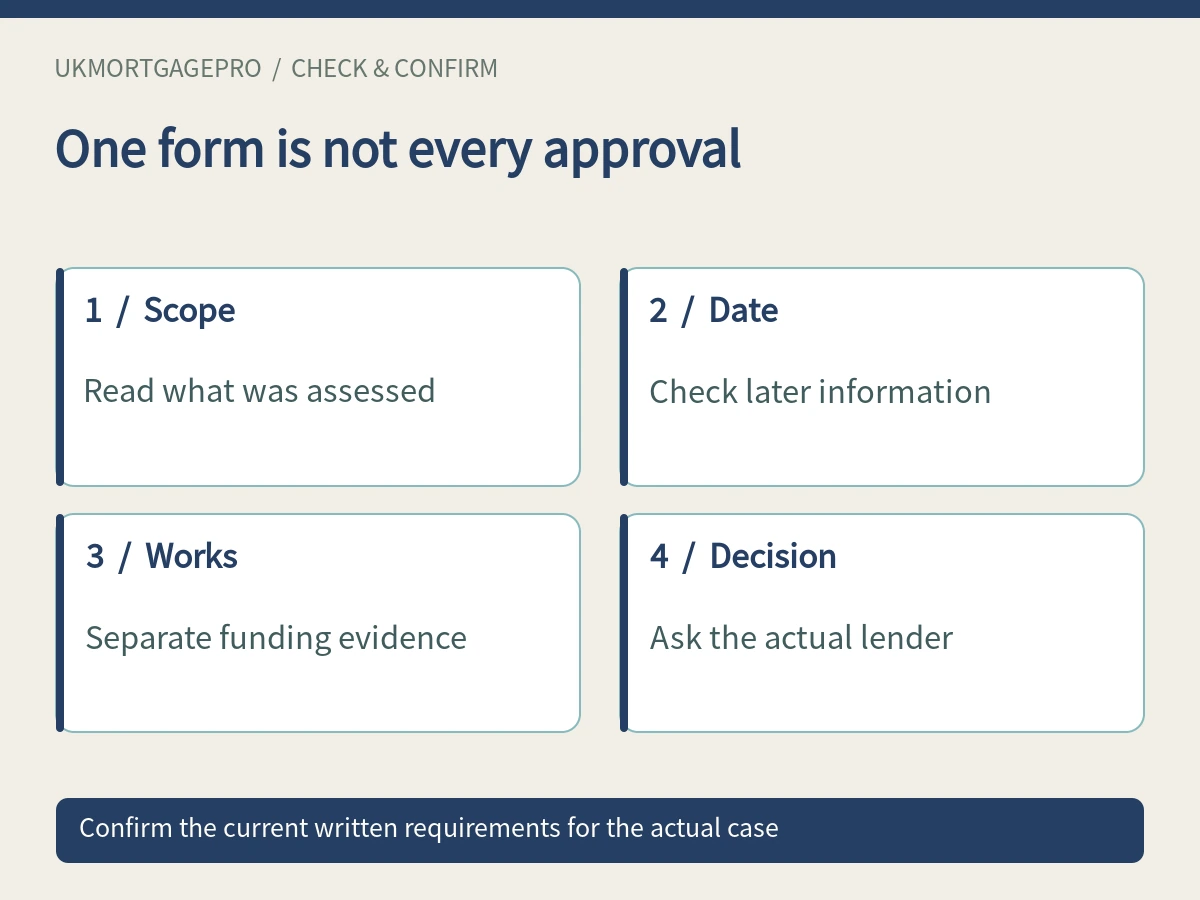
Do not reduce the check to a date on a single page. RICS discusses existing form versions, later appraisals and works that may affect earlier conclusions. It also directs users to individual lender policy when considering older forms. Record any known later assessment or relevant building work and ask whether the document in hand remains suitable for this transaction. A previous mortgage approval is not proof that a different lender will accept the same evidence today. Equally, a missing document is a question for the responsible parties; it is not a technical assessment of the building.
Keep the November 2026 change in the correct time period
Source review was carried out on 11 October 2026. RICS states that the second edition of its secured-lending valuation guidance was published in May 2026 and has an effective date of 1 November 2026. That effective date had not arrived when this article was reviewed. Publication and commencement are different events. Do not treat a future-dated standard as already governing a current valuation, or assume every existing form becomes invalid on that date. Ask the instructed valuer and lender which guidance and evidence apply to the actual valuation and completion timetable.
If remediation is involved, ask separate funding and evidence questions
Where the documents indicate work is needed, the fact that a programme has been announced does not establish the funding arrangements, the scope of works or the lender’s decision on your flat. Ask which party is responsible, what documentary evidence is available and what remains unconfirmed. Your conveyancer may need to examine legal and cost questions, while the valuer considers the property and the lender applies its criteria. Avoid promising a contractor, buyer or another creditor that mortgage funds will arrive on a date inferred from an assessment appointment or a general building update.
Geography and the individual lender still matter
RICS discusses different arrangements across the United Kingdom, including differences affecting Scotland. Do not transplant an English leaseholder-protection conclusion into a Scottish transaction, or treat a lender’s published policy for a specific category of flat as a market-wide rule. Start with the property’s actual jurisdiction and use professionals familiar with it. If a lender asks for particular documents, keep that request alongside its date and the property it concerns. A competitor’s checklist may help you spot questions, but it cannot certify your building or establish that UKMortgagePro can arrange a particular product for you.
Prepare a useful consultation without exposing private records
For an initial UKMortgagePro enquiry, a short factual summary is enough: the property’s region, whether it is owner-occupied or let, the intended remortgage purpose, which external-wall documents are held, and whether works or further enquiries are known to be outstanding. Do not post full signed reports, identification, bank statements or private resident information in public comments. Use the existing consultation route to discuss the next steps and the division of responsibilities. The information here is educational, not personal financial advice, a building-safety opinion, a valuation or a lender commitment.
Practical checklist
- Identify the exact building and the complete document, not only a headline rating.
- List dates, related reports and known later works or assessments.
- Keep wider safety, legal, valuation and lending questions separate.
- Check the actual applicable guidance and do not bring 1 November 2026 forward.
- Ask the lender or valuer what is still needed for this particular transaction.
Questions to clarify
Does an EWS1 form prove that every part of a building is safe?
No. RICS distinguishes its external-wall valuation purpose from a life-safety certificate and wider fire-risk assessment.
Does a previous lender’s acceptance guarantee my remortgage?
No. The current lender, valuation and legal review relate to the present application and its actual evidence.
Should I automatically order a replacement form because new guidance was published?
Do not infer that from publication alone. Ask the building’s responsible parties and your lender or valuer about the applicable evidence, dates and circumstances.
Sources and scope
- RICS: Cladding External Wall System (EWS) FAQs — checked 2026-10-11; page publication/update date: Page update date UNKNOWN; cited second edition published May 2026, effective 2026-11-01
Public information and document-organisation guidance only; not personal mortgage, legal, tax, valuation or investment advice, and not lender approval or endorsement. Confirm current case requirements with the responsible professionals.
Related information and consultation
UK remortgage preparation · Mortgage application information · News and practical guides · Arrange a consultation. Enquiry acknowledgement is not mortgage approval.