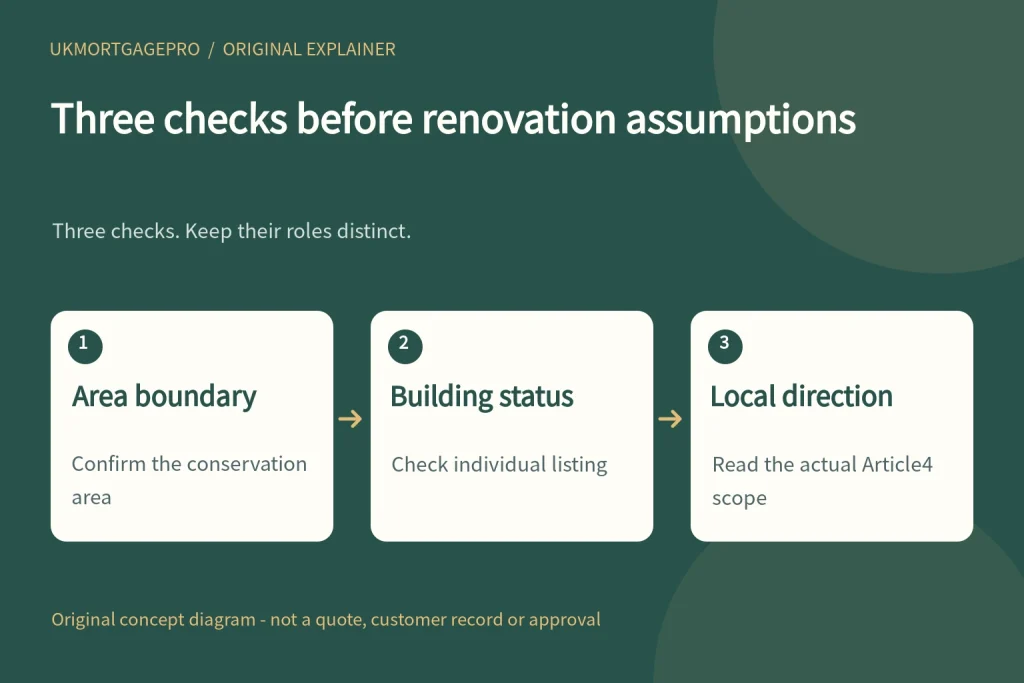
UKMortgagePro original relationship diagram: Area boundary / Building status / Local direction. The three checks do not replace one another.
The short answer: three different checks
A conservation-area address, an individual listing and an Article 4 direction should not be treated as three names for the same thing. Historic England describes conservation areas as places whose architectural or historic character warrants protection. Its homeowner guidance explains that local controls can affect proposed changes, while separate requirements apply where a building is also listed. For a buyer living overseas, the practical task is to establish which descriptions actually apply to the property, then ask the responsible professionals about the proposed use and works. None of these labels is, by itself, a mortgage decision.
Confirm the conservation-area boundary with the local authority
Historic England advises contacting the local planning authority to establish whether a property is in a conservation area, when the area was created, its extent and the protections in place. Start with the actual property address and, where necessary, the land included in the transaction. A neighbourhood name or estate-agent description is not a substitute for the relevant boundary information. Keep the source and date of the reply so that a later discussion is not based on an undated screenshot. The guidance in this article is for England; do not assume the same records or procedures apply throughout the UK.
Check individual listed status as a separate question
Being in a protected area does not remove the need to establish the status of the particular building. Equally, a statement that a building is not individually listed should not be used to dismiss the area's planning controls. Ask the conveyancer or appropriate adviser to identify the relevant records and explain their scope for the property being purchased. This article is about that initial classification task. It does not decide the extent of any listing, interpret a particular entry or establish that previous alterations were lawful. Existing work records need their own assessment once the applicable status is understood.
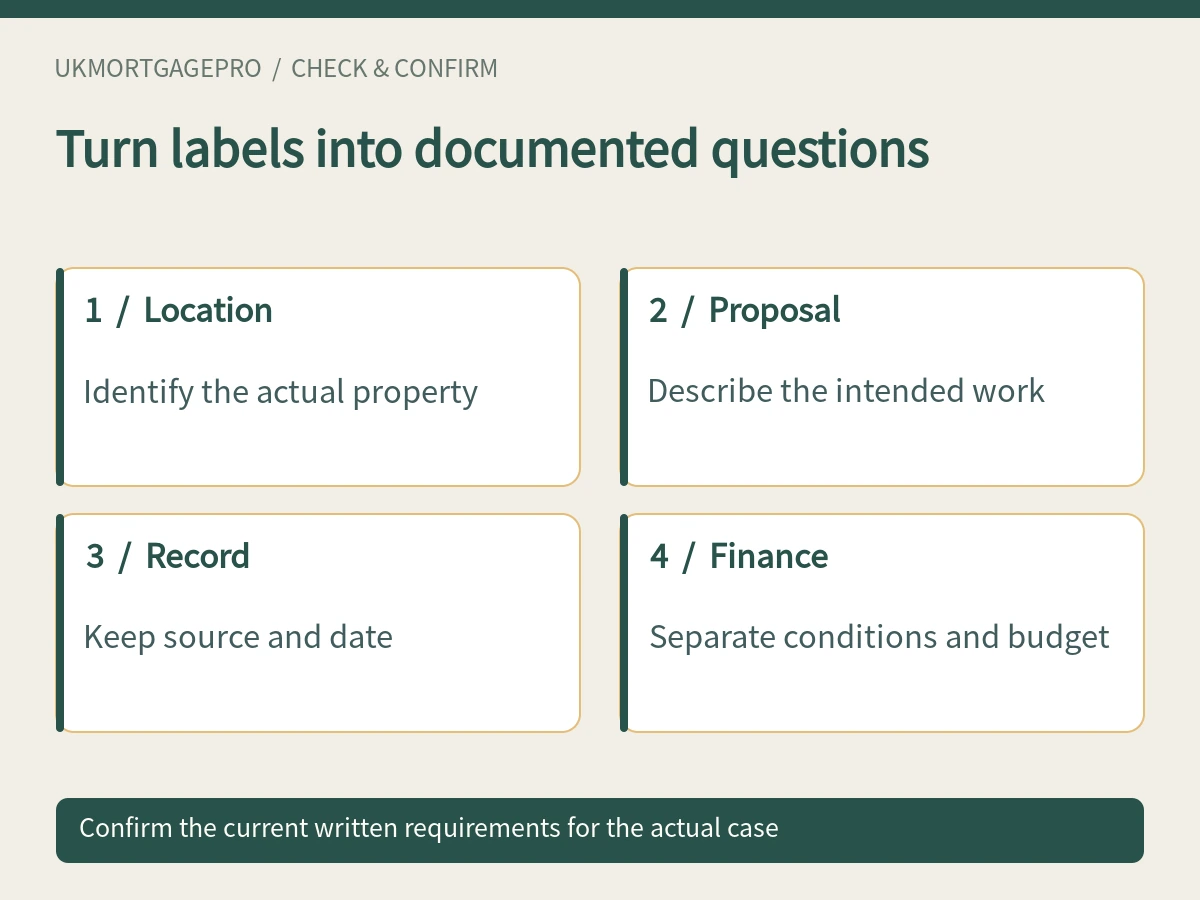
Ask precisely what an Article 4 direction covers
Historic England explains that an Article 4 direction may restrict work that would otherwise not require planning permission, with controls tailored by the council to the area concerned. Do not assume that every conservation area has identical restrictions, or that one direction covers every kind of alteration. Ask the local planning authority whether a direction applies to the property and which works it affects. A useful question names the actual proposal, such as a window change, rather than asking whether the house can be modernised in general. The answer should be linked to the relevant local document, not a neighbour's project.
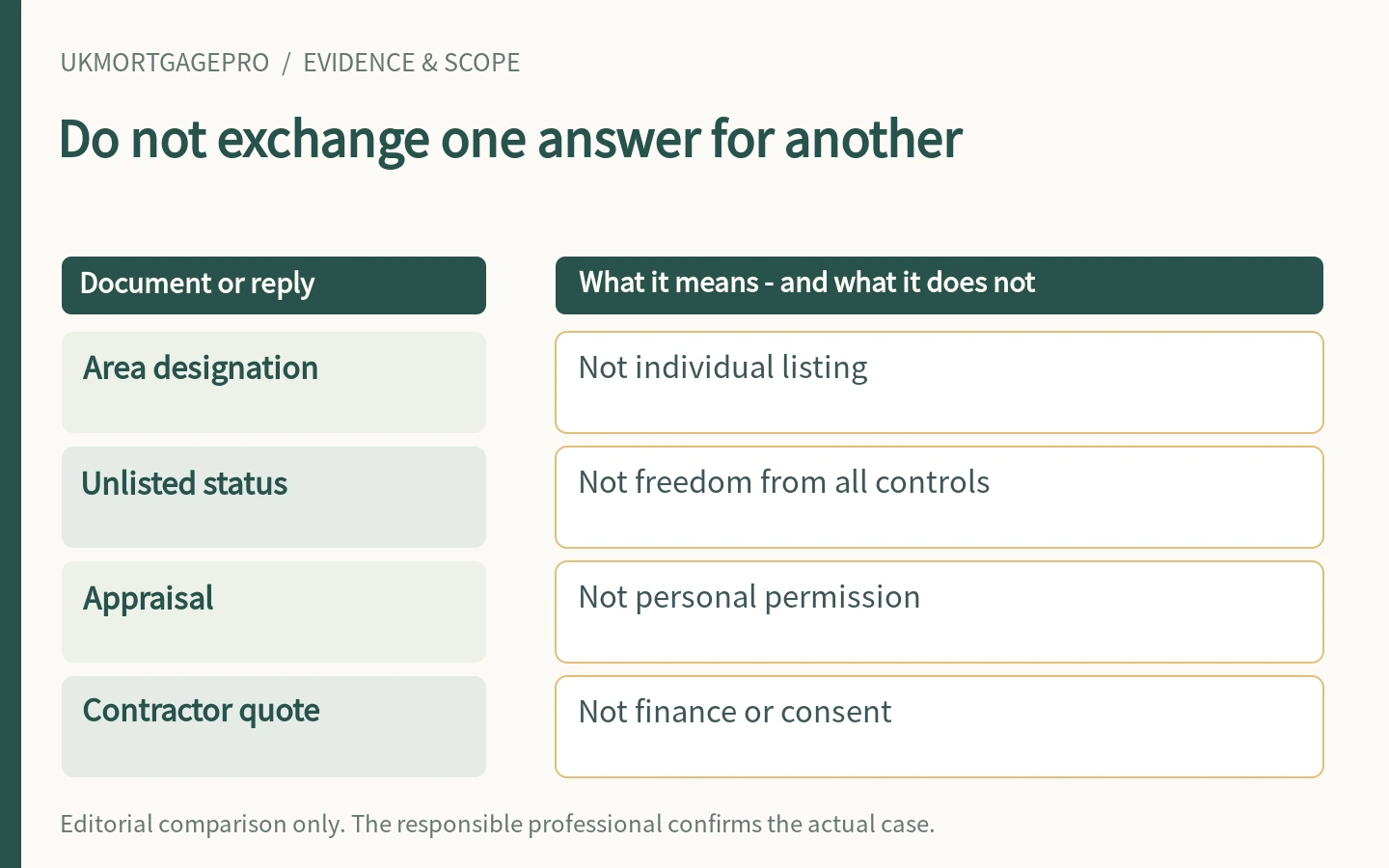
Use the appraisal to understand the area's character
A Conservation Area Appraisal can explain the area's history and the features that make it special. Historic England notes that local authorities may also publish supplementary planning material about management of the area. These documents help buyers frame better questions about their plans; they are not personal permission to undertake the plans. If your renovation budget depends on changing external materials, openings or another visible feature, identify that dependency before treating an estimate as a settled project cost. A general design idea should remain provisional until the required advice and permissions are clarified.
Keep permissions and other requirements in separate columns
The need for planning permission is not confined to historic buildings. Historic England's permissions guidance also distinguishes listed-building consent and other protections where relevant. Trees and demolition can raise additional questions in conservation areas, but the answer depends on the actual proposal and applicable rules. Rather than copying a universal permission checklist, ask the local authority and the transaction advisers what is relevant to your property. Record each requirement, responsible person and current status. An answer about one form of consent should not be used as proof that all other requirements have been satisfied.
Make renovation assumptions visible in the mortgage discussion
If the purchase or refinancing plan depends on works, explain what has been confirmed and what is only proposed. A lender's view of the application is separate from the planning authority's decisions and any legal or technical assessment. This guide has not verified a lender-specific policy for conservation-area properties and makes no approval or rejection promise. Likewise, the fact that a seller has received a quotation from a contractor does not establish permission, the final scope of work or funding availability. Separate the acquisition budget, provisional work budget and outstanding professional enquiries.
Prepare a concise overseas-buyer handover
A clear starting note includes the property location, intended use, transaction stage, whether any works are essential to your plan and the records you actually hold. List conservation-area status, listed status and Article 4 enquiries independently, using unknown where appropriate. UKMortgagePro's existing consultation route can be used to discuss the mortgage enquiry and the information still needed. It is not a planning authority, a permission certificate or a substitute for the conveyancer's advice. Send sensitive transaction and identity documents only through the appropriate agreed channels, not in a public website message.
Practical checklist
- Confirm the specific address against the relevant conservation-area information.
- Check individual listing separately and ask about the scope of any Article4 direction.
- Read the local appraisal or relevant management material without treating it as permission.
- Keep essential works, required consents and financing assumptions distinct.
Questions to clarify
Does conservation-area status mean the house is individually listed?
No. Treat area designation and the building's status as separate enquiries; the relevant records and professional interpretation determine what applies.
Can I copy a neighbour's window replacement?
A neighbour's work is not evidence of your permission. Ask about your exact proposal, property and any applicable local direction.
Does an unlisted house avoid every extra control?
No. Historic England explains that conservation-area and Article4 controls can affect work on buildings in the area even when the question of listing is separate.
Sources and scope
- Historic England: Designating and Managing a Conservation Area — checked 2026-10-11; page publication/update date: not stated or not established
- Historic England: Living in a Conservation Area — checked 2026-10-11; page publication/update date: 2012-11-20 (published; current update date not displayed in retrieved text)
- Historic England: What Permission Might I Need to Make Changes to My Older Home? — checked 2026-10-11; page publication/update date: not stated or not established
Public information and document-organisation guidance only; not personal mortgage, legal, tax, valuation or investment advice, and not lender approval or endorsement. Confirm current case requirements with the responsible professionals.
Related information and consultation
Non-resident UK mortgages · UK mortgage information · News and practical guides · Arrange a consultation. Enquiry acknowledgement is not mortgage approval.