The property label is only a starting point
A Singapore bank UK mortgage enquiry for a London shop and flat needs to explain what the proposed security actually includes. A separately purchased flat above a shop is not necessarily the same transaction as buying the whole shop-and-flat building. This guide focuses on that distinction, not general location or currency selection. It does not decide whether any bank accepts a particular property, and it does not label every flat above commercial premises as mixed-use collateral.
What the public bank page establishes
DBS Treasures Private Client publishes an overseas property financing offering for London Zones 1 and 2, including completed and under-construction property options. The public description does not, by itself, establish approval for the reader’s shop-and-flat security or explain every possible commercial-use arrangement. This article is not a DBS product quotation, a rejection rule, a partnership announcement or an instruction to open an account. Obtain a response for the actual property from the responsible bank team.
Start with the purchase boundary
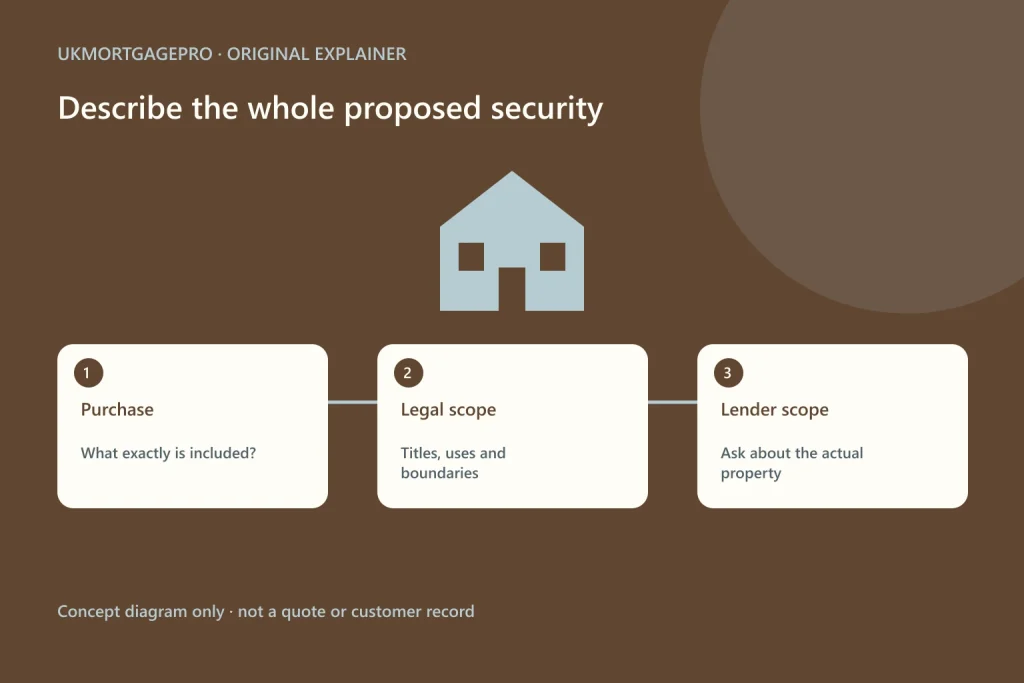
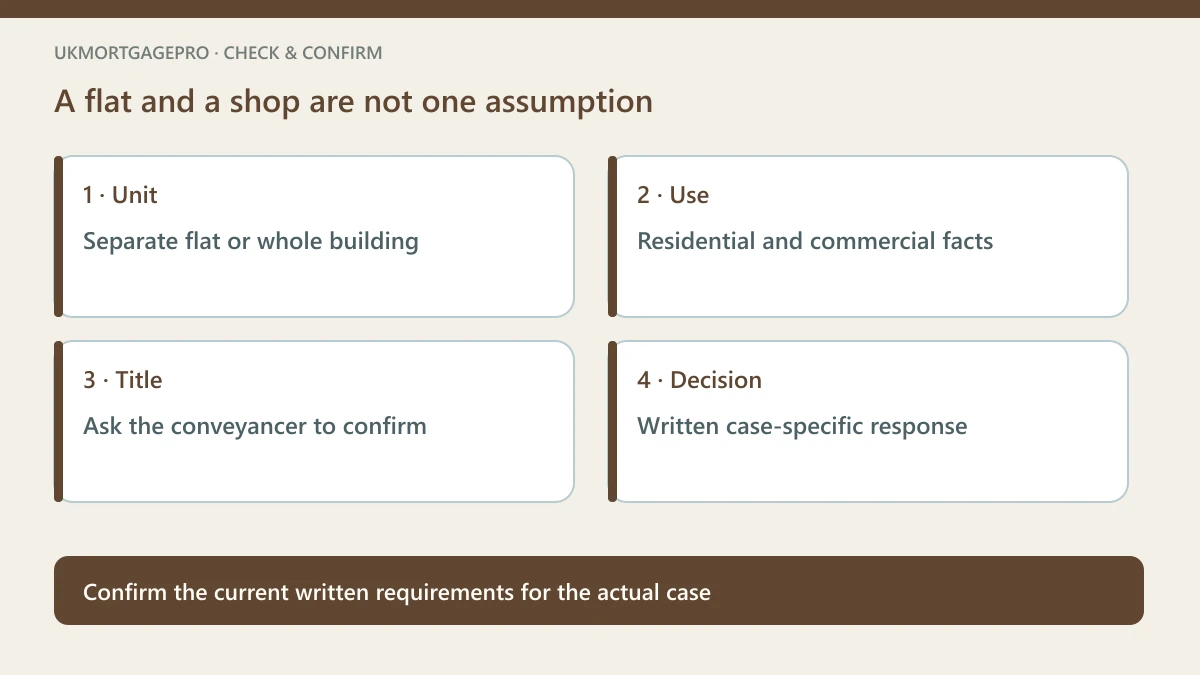
Describe whether the purchase comprises a flat only, a shop only, or a larger interest including both. Marketing expressions such as investment opportunity or London property do not answer that question. Ask the conveyancer to confirm the legal extent of what is being bought rather than inferring it from a photograph or address. Do not remove a commercial component from the description merely to make an enquiry resemble a standard residential purchase.
Keep occupation and legal extent separate
Record the actual uses and occupants of the spaces, while leaving legal interpretation to the conveyancer. A flat can be residential even when another unit in the building has a different use, but that fact alone does not answer the lender’s security question. Conversely, describing a building as containing a home does not establish that the entire interest is suitable for a home-loan product. The bank and conveyancer need to address their respective questions.
Ask a specific collateral question
An enquiry can ask whether the exact proposed interest, including the described commercial and residential elements, is within the relevant product scope. Provide a concise factual summary and ask what further property documents are needed. Do not assume that the bank has reviewed the title simply because it discussed a loan amount. A preliminary conversation or received enquiry is not a formal acceptance of the collateral or an approved borrowing limit.
Rental descriptions need clear boundaries
Where there are separate rental receipts or proposed lettings, identify which space produces each amount. Do not present shop rent as residential-flat rent, or combine unrelated figures without explaining them. Ask the responsible adviser what income the product can consider and what evidence it requires. This article provides no rental coverage calculation, yield estimate or valuation. It also does not advise how commercial or residential income should be treated for tax.
Valuation is another distinct question
The DBS public page notes that financing quantum relates to purchase price or indicative valuation, whichever is lower. That limited statement does not tell a reader how a mixed-use interest will be classified or valued. Ask the bank about its process and ask the conveyancer about legal questions; do not invent a split valuation or apply a residential loan percentage to a whole building. An agent’s asking price and a lender’s assessment are different evidence.
A simple enquiry example
Suppose an advertisement describes a London flat above a shop, but the buyer has not confirmed whether the offered interest is the flat alone or the entire building. The next useful question is about that purchase boundary, followed by a case-specific bank scope check. This is an illustrative information gap, not a real borrower or approval case. It is not a reason to reserve a property before understanding the legal interest and financing conditions.
Do not turn an absence into a rule
If the public page does not answer the question, record that it remains unconfirmed. Silence is not approval and is not proof that every bank refuses the property. Keep bank replies, property facts and legal advice distinguishable, and disclose later changes to the actual transaction. UKMortgagePro can help organise UK-property financing enquiries, but does not certify titles, value property or issue bank approvals. First-party material was checked on 7 October 2026; confirm the current route with the responsible professionals.
Practical checklist
- Clarify a separate flat versus the whole shop-and-flat interest.
- Describe actual uses without hiding commercial elements.
- Ask about the exact collateral and required property evidence.
- Keep valuation, legal review and lender acceptance separate.
Questions to clarify
Does a London location prove a mixed-use property meets a Singapore bank home-loan offering?
No. Location and the actual security scope require separate confirmation.
Does this article say all flats above shops are ineligible?
No. It does not determine eligibility and distinguishes a separate flat from an entire mixed-use interest.
Sources and scope
- DBS Treasures Private Client — Overseas Property Financing — checked 2026-10-07; page publication/update date not stated or not established
Public information and document-organisation guidance only; not personal mortgage, legal, tax, valuation or investment advice, and not lender approval or endorsement. Confirm current case requirements with the responsible professionals.
Related information and consultation
Singapore bank financing for UK property · UK mortgage information · News and practical guides · Arrange a consultation。Enquiry acknowledgement is not mortgage approval.