Start with the payment period
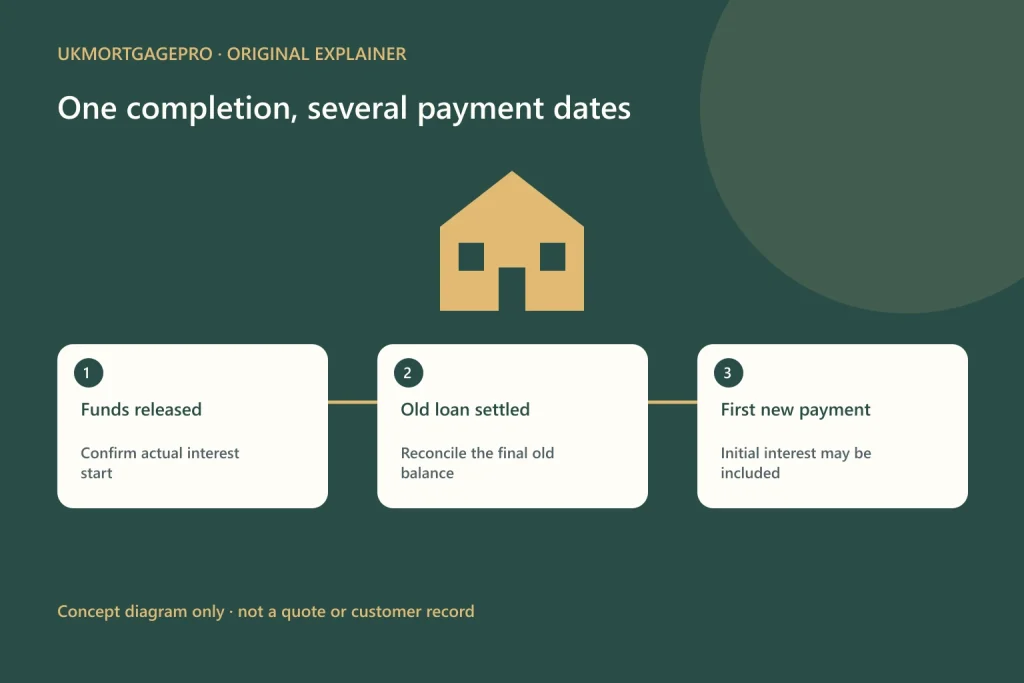
When assessing UK remortgage costs, the monthly figure shown in an illustration is not always the amount that will leave your account on the first collection date. A new loan may include an initial period of interest before the usual monthly cycle begins. This article addresses that timing issue, rather than repeating a list of product, legal or exit fees. It does not calculate a personal saving or assume that two payments appearing near each other are an error.
Ask for the new lender’s explanation
Nationwide’s intermediary payments page says its first payment often includes interest from the date funds are released until the end of that month, as well as the normal payment for the following month. It also describes a written first-payment notice. This is a specific lender example, not a rule for every UK mortgage. For the actual case, check the offer, the applicable mortgage conditions and the first-payment notice, including the actual interest-start date and the period represented by each amount.
Keep funds release and completion distinct
The date the new lender sends funds, the date the conveyancer completes the remortgage and the collection date can be separate events. Do not assume the loan starts only when you see the new direct debit. Equally, do not assume the advertised completion date remained unchanged. Ask the case handler to confirm the real dates and any effect of a delay. The relevant documents, rather than a website example or calendar guess, should determine how interest is charged.
Reconcile the old mortgage without changing it
The old lender’s settlement calculation and a normal payment already collected may need to be reconciled. The useful question is which period the collection covered and how it was treated in the final account. Do not stop or cancel a real payment arrangement because an online article suggests the old loan should be finished. Continue to follow the existing lender’s instructions until settlement and the account outcome are confirmed. A refund expectation is not money available for the next collection date.
Two nearby collections are not a diagnosis
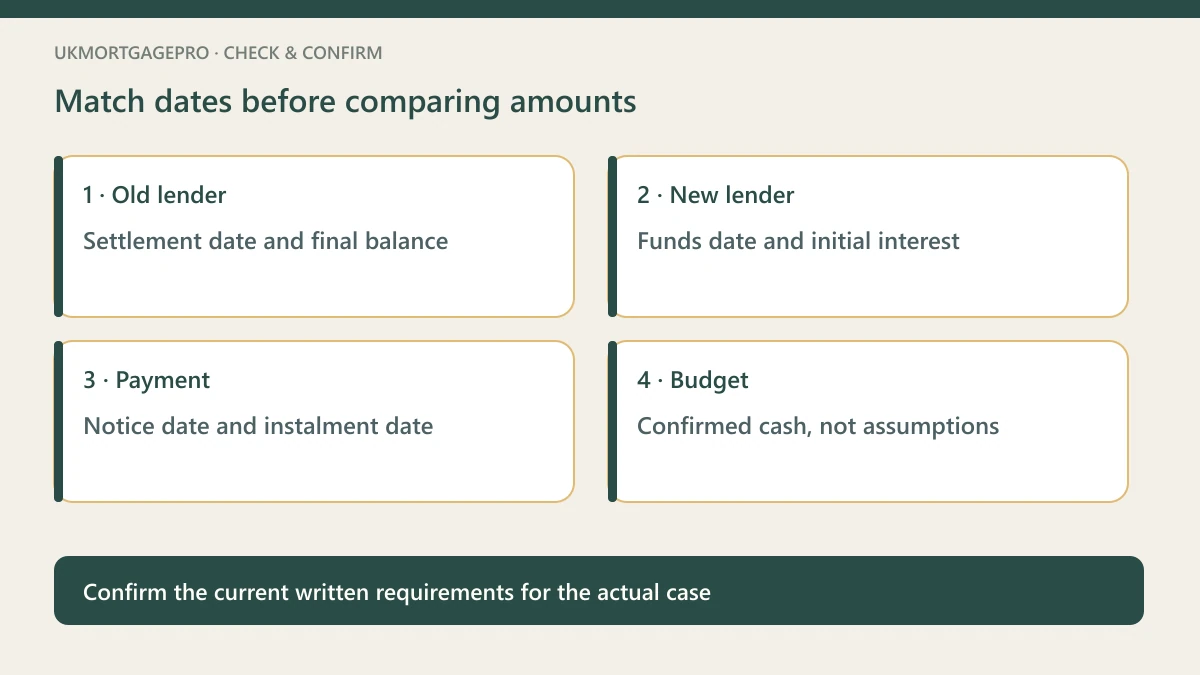
Seeing an old payment and a new payment in the same calendar month does not by itself prove interest was charged twice for the same period. Nor does it prove the calculation was correct. Make a neutral record of the amounts, collection dates and periods, and compare it with both lenders’ documents. If an item cannot be reconciled, ask the responsible lender or conveyancer to explain it in writing. Do not invent an overlapping number of days or a refund amount from a bank statement alone.
Separate interest from transfer charges
A charge for transferring mortgage funds is a different category from interest accruing on the loan. HSBC’s public fees page, for example, describes a completion transfer fee separately from other mortgage costs. Do not import that bank’s current amount into another lender’s comparison. Keep confirmed one-off charges, initial interest and ongoing instalments in separate rows, with a source and date for each. This prevents an initial-interest amount from being mistaken for a permanently higher monthly payment.
Make a short cash calendar
Prepare a calendar containing the expected old collection, expected settlement, first new collection and ordinary new monthly payment. Mark dates as expected or confirmed. Add the source document next to each, and retain a separate line for any refund still awaiting confirmation. A working calendar helps organise available cash but is not a substitute for affordability checks or a lender’s statement. If the completion date changes, revisit the calendar rather than assuming the first-payment illustration stays accurate.
Use a consistent cost comparison
For a product comparison, show the same borrowing amount and comparison period. Identify whether the quoted totals include initial interest, product fees, interest on added fees and old-loan charges. A difference caused by dates is not necessarily a product advantage. A lower first payment can also reflect a shorter first interest period rather than a cheaper loan. Ask a suitably qualified adviser to compare the products on a consistent basis; do not select a deal solely because the first collection looks smaller.
What to bring to the first conversation
An initial enquiry can state the intended completion month, current deal end month and whether the first-payment notice has arrived. It need not include account numbers, complete statements or access credentials. Later, share sensitive documents only through the channel agreed with the authorised case handler. UKMortgagePro can help organise these questions but does not confirm lender calculations, promise a refund or give personal mortgage advice. Your property may be repossessed if you do not keep up repayments.
Practical checklist
- Identify the period and date behind the first collection.
- Separate initial interest from a transfer or completion fee.
- Reconcile the old lender’s final account using written evidence.
- Budget for unconfirmed refunds as pending, not available cash.
Questions to clarify
Does a larger first payment mean the deal is more expensive?
Not necessarily. The first payment can cover a different interest period; compare the confirmed total costs on consistent dates.
Should I cancel the old direct debit myself?
Do not treat this article as an instruction to change a payment arrangement. Follow the lender’s existing instructions and obtain confirmation of settlement.
Sources and scope
- Nationwide for Intermediaries — Payments — checked 2026-10-03; page publication/update date not stated or not established
- HSBC UK — Mortgage fees — checked 2026-10-03; page publication/update date not stated or not established
Public information and document-organisation guidance only; not personal mortgage, legal, tax, valuation or investment advice, and not lender approval or endorsement. Confirm current case requirements with the responsible professionals.
Related information and consultation
Remortgage information · Mortgage information · News and practical guides · Arrange a consultation。Enquiry acknowledgement is not mortgage approval.