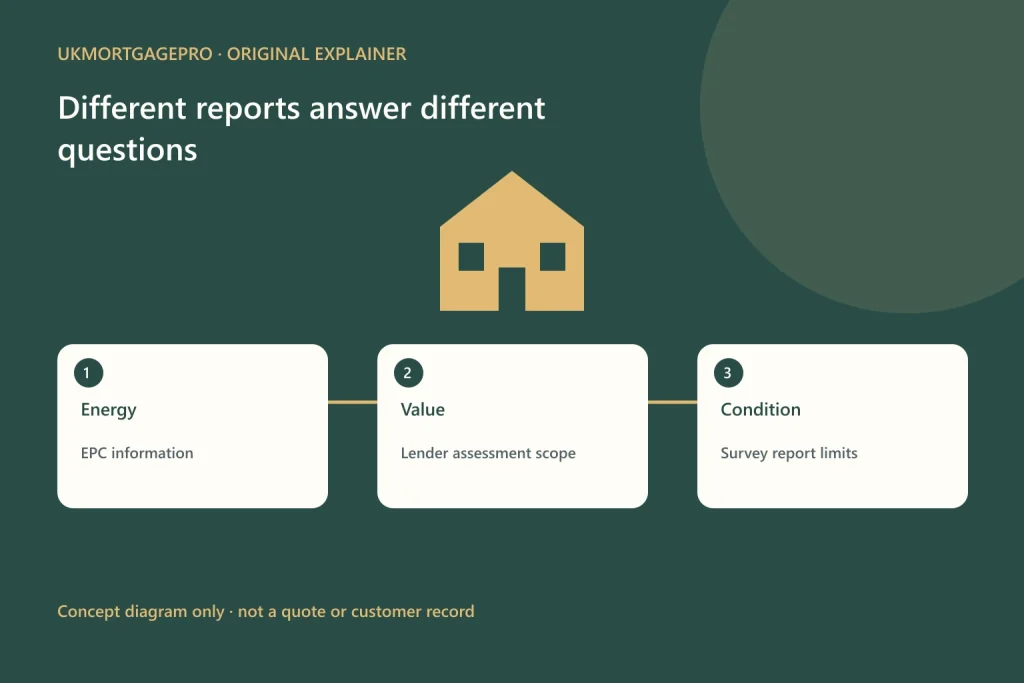
UKMortgagePro original information diagram; not a product quote, real customer record or approval.
Name the report before using its conclusion
In a UK property refinance discussion, a homeowner may have an Energy Performance Certificate, a valuation-related document and an older survey. Their existence does not mean the same question has been checked three times. Start by naming each report and its purpose. This guide concerns evidence organisation, not energy-upgrade recommendations, survey selection or mortgage eligibility. It does not certify the building’s condition, predict repair costs or establish what a particular lender will accept for the proposed transaction.
Energy information has a defined purpose
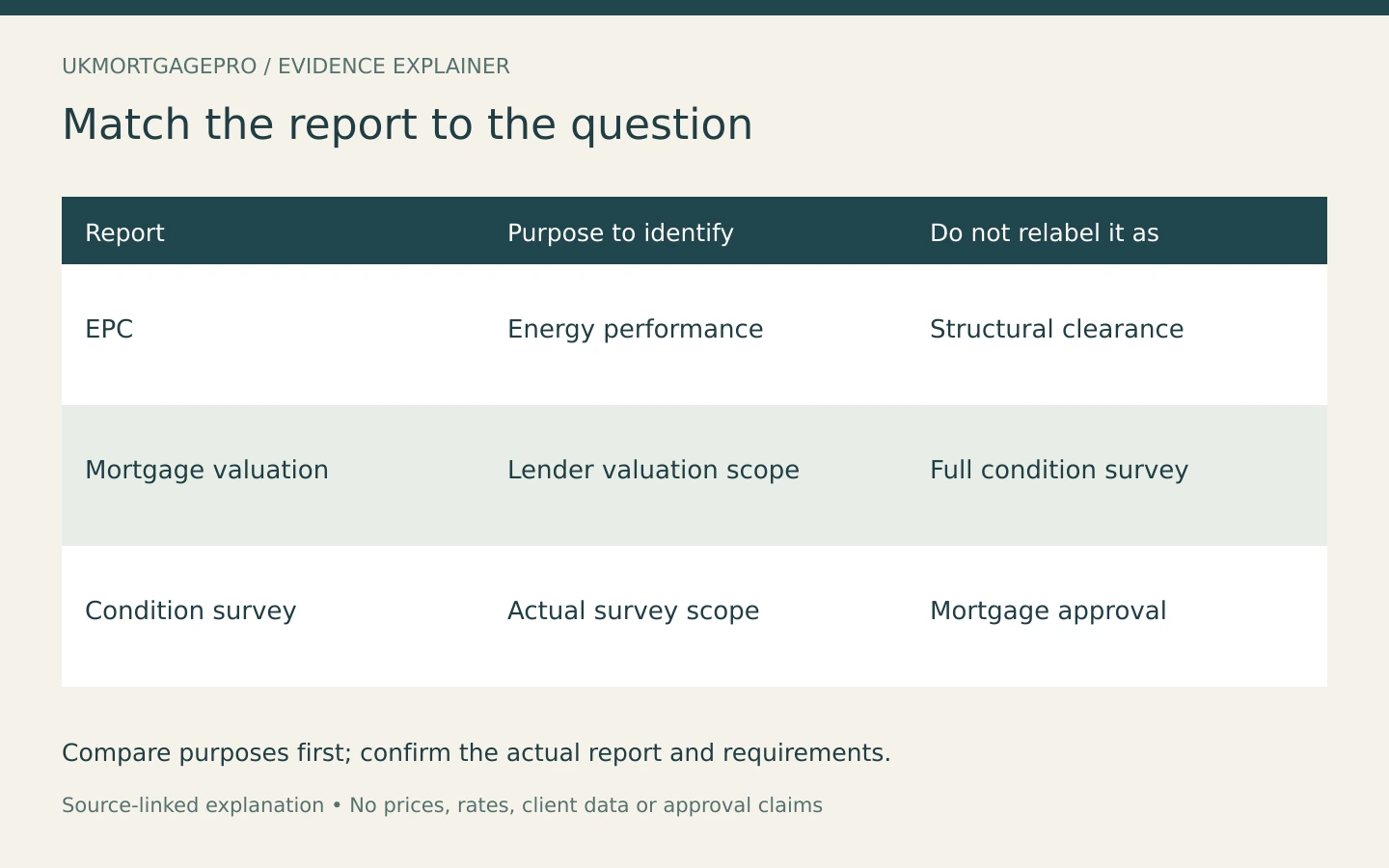
GOV.UK explains that an EPC provides information about a property’s energy efficiency, energy use and typical energy costs, together with suggested efficiency improvements. That limited description does not make the certificate a structural assessment. The inference here is straightforward: a document explaining energy performance should not be relabelled as evidence that every building-condition issue is cleared. This article does not interpret a particular EPC, claim all homes need identical ratings or give an individual exemption decision.
A valuation is not the same as a full survey
MoneyHelper distinguishes a mortgage valuation from a full structural survey in its public home-buying guidance. It also describes different condition-survey levels. Those explanations help identify separate purposes; they are not being presented as a compulsory refinance survey package. Ask the lender what assessment it requires and ask the appropriate surveyor what the actual report covers. Do not infer that a valuation fee, free valuation offer or a quoted property value includes every condition check an owner might need.
Record who prepared each item and when
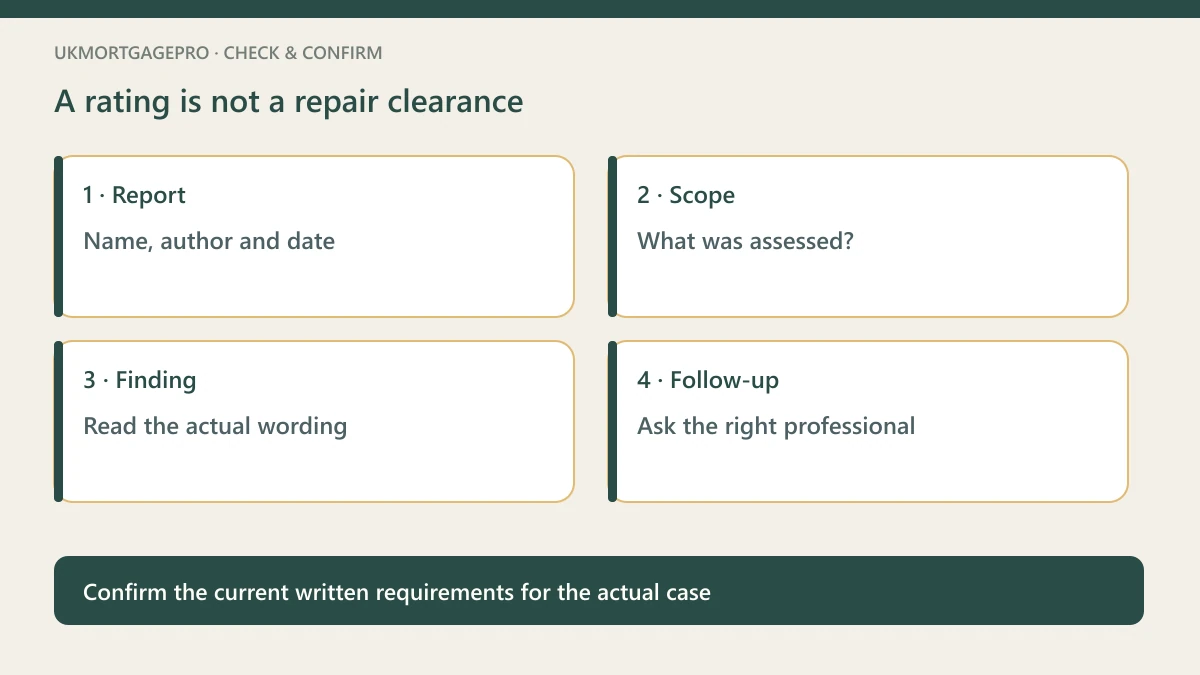
A short file index can identify the report name, the author or issuing organisation, the property it describes, the report date and any stated scope limitations. Use the actual wording rather than an enthusiastic summary such as fully checked. If the owner has only a partial copy, label it as partial. Do not remove qualifications or append an approval label that the author did not give. The responsible recipient can then decide whether the existing document answers the question raised by this particular enquiry.
Keep actual findings in their own context
An efficiency recommendation, a condition observation and a valuation figure should remain associated with their original reports. A higher energy rating does not, by itself, explain a crack, leak or other concern, and this article does not diagnose any such feature. Conversely, a condition report is not automatically a current EPC. If a report recommends further investigation, record that recommendation accurately and ask the appropriate professional about it. Do not convert further review required into no action needed simply because finance is the immediate goal.
Changes to the property need an honest description
If the owner knows that alterations, equipment changes or repairs occurred after a report, explain that history and the available evidence. Do not declare the report invalid, or confidently current, without appropriate advice about its scope. The useful question is whether the recipient needs updated information for the actual transaction. This guide does not tell the reader to commission unnecessary repeat work or change the building for a loan. Technical, legal, energy and finance decisions must be confirmed by those responsible for them.
Do not buy an assessment simply to fill a list
A longer document bundle is not automatically a better enquiry. Before commissioning a service, clarify which question needs answering, who requires the answer and what existing information is available. The public MoneyHelper page concerns buying and selling, so its examples are not a universal instruction for all refinancing. This article reproduces no survey prices and recommends no provider. Obtain appropriate case-specific advice, including the service’s actual scope and cost, rather than paying for work solely because an online checklist mentions a report title.
An invented example of an evidence mix-up
Imagine an owner describes a good energy rating as proof that no repairs are needed, even though no condition assessment is available. A clearer summary identifies the EPC’s purpose and separately labels the building-condition question unanswered. It does not claim a defect exists or that the mortgage will fail. This is a fictional document example, not a real homeowner, survey result or approved loan. The next appropriate enquiry concerns the actual property and the responsible professional’s requirements, not a promise supplied by the example.
Keep the lender response separate from technical advice
A lender receiving an energy certificate does not mean it has accepted all property-condition issues. A surveyor describing a feature does not approve a refinance application. Keep written replies associated with the question asked, their date and any remaining conditions. Ask who is addressing an unresolved point rather than forwarding the same document under a different name. An intended finance completion date should remain a target, not a reason to rewrite the technical findings or omit a known property issue from the enquiry.
Make the first conversation clear and proportionate
For an initial discussion, identify the property type, refinance purpose, which reports exist and what remains unclear. Avoid posting full addresses, reports, policy numbers or personal records publicly. The GOV.UK and MoneyHelper guidance was checked on 8 October 2026; publication dates were not established. UKMortgagePro helps organise enquiries, not certify energy performance, select a personal survey product or make lender decisions. Follow current professional advice for the property and the actual lender’s written requirements before treating any issue as resolved.
Practical checklist
- Label EPC, valuation and condition reports by their different purposes.
- Record actual authors, dates, scope and unresolved findings.
- Disclose known changes without inventing report validity.
- Ask which question needs answering before commissioning repeat work.
Questions to clarify
Does a good EPC rating prove a property has no structural concerns?
No. An EPC describes energy performance; it is not a structural or property-condition clearance.
Must every refinancing customer order all survey types?
This article makes no such claim. Confirm the actual question, existing evidence and case-specific lender and professional requirements.
Sources and scope
- GOV.UK — Selling a home: Energy Performance Certificates — checked 2026-10-08; page publication/update date not stated or not established
- MoneyHelper — Mortgage fees and costs when buying or selling a home — checked 2026-10-08; page publication/update date not stated or not established
Public information and document-organisation guidance only; not personal mortgage, legal, tax, valuation or investment advice, and not lender approval or endorsement. Confirm current case requirements with the responsible professionals.
Related information and consultation
UK refinancing information · Property mortgage enquiry questions · News and practical guides · Arrange a consultation。Enquiry acknowledgement is not mortgage approval.