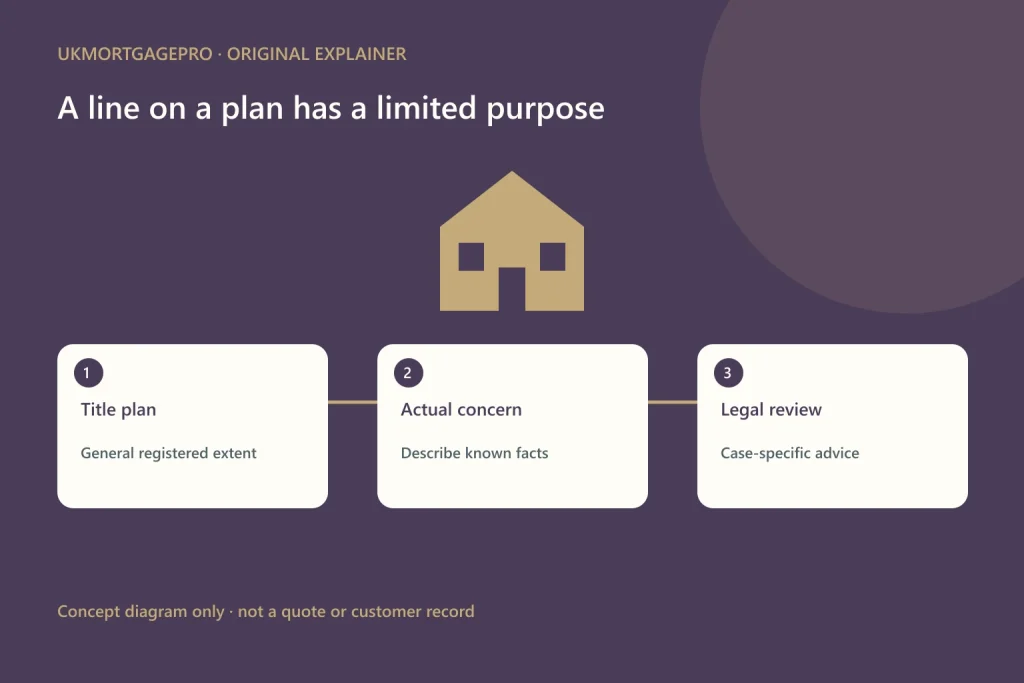
UKMortgagePro original information diagram; not a product quote, real customer record or approval.
Start with the question, not a zoomed image
A UK property refinance enquiry can include a title plan with a red outline around the registered land. That image is useful context, but it should not be presented as an exact measurement of a disputed boundary. This article concerns how to describe the evidence for an England or Wales property enquiry. It does not decide ownership, assess a neighbour’s claim, draw a legal boundary or establish whether a lender will accept the property. Scotland and Northern Ireland require their appropriate guidance.
What the first-party guidance actually establishes
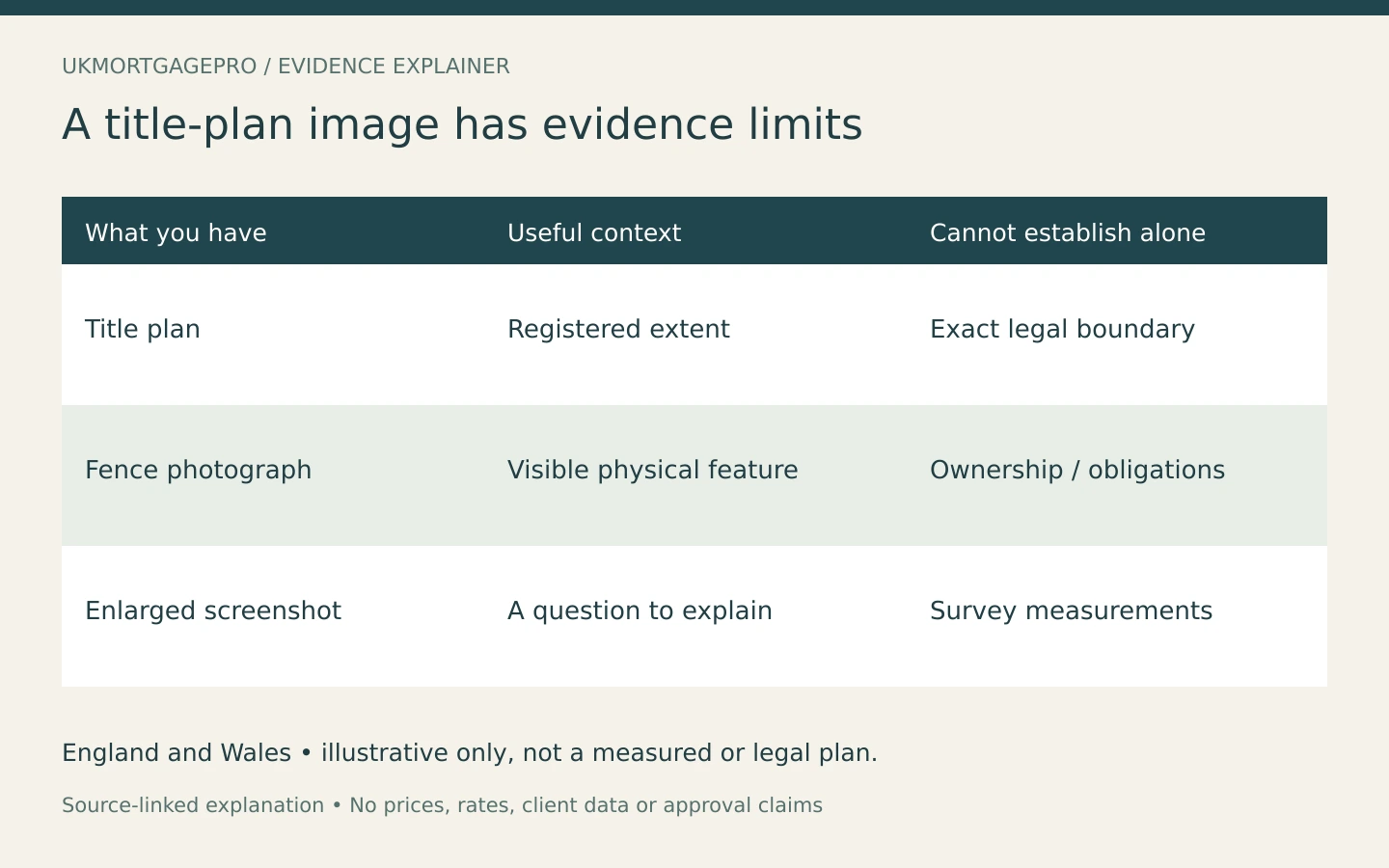
HM Land Registry explains that a title plan supports the property description in the register. Its guidance warns that the red edging is not the exact position of a legal boundary or proof of who owns a boundary feature. It also warns against locating that boundary by scaling up measurements from the plan. These are the limited facts used here. They do not establish that a particular fence is wrongly placed, that an owner has lost land or that an application must be refused.
Keep the plan connected to its register
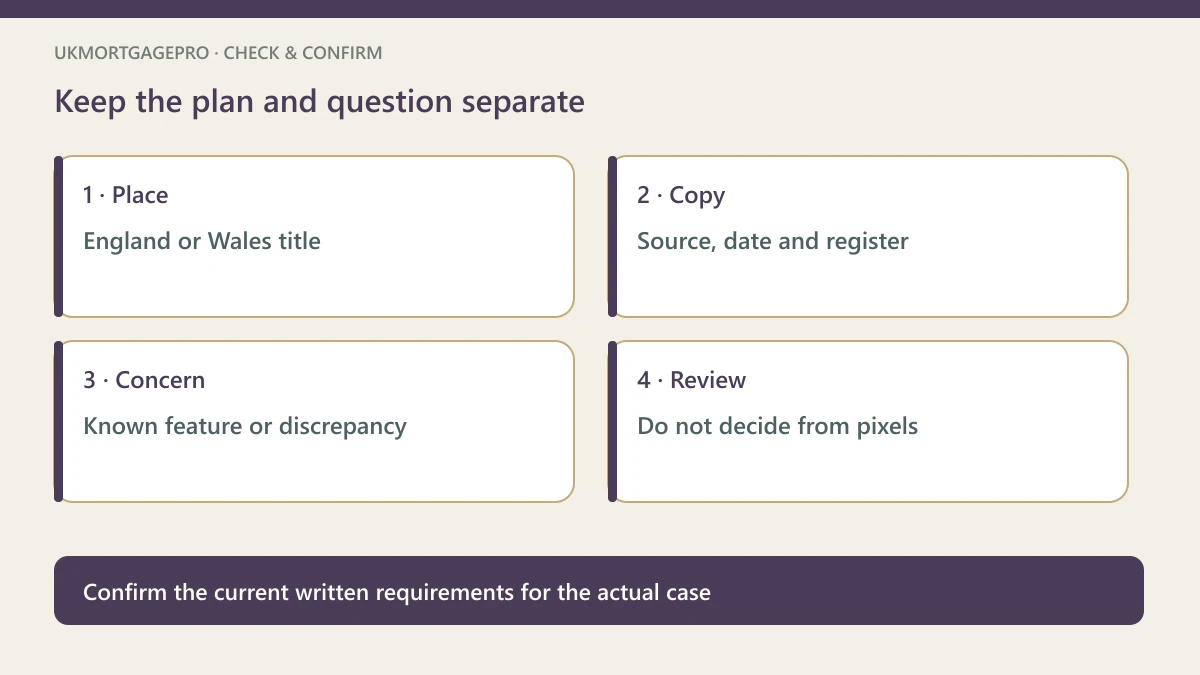
When organising a file, record which title and dated copy the plan relates to, and which accompanying register or referred documents are available. Do not separate an image from its context and rename it a certified site measurement. If you have only an estate-agent diagram or a photograph of a printed plan, describe it as that. Ask the conveyancer which actual documents the transaction needs. This guide does not instruct the reader to order a paid copy, amend a register or select a legal application.
Describe a visible feature without deciding ownership
An initial note can say that there is a fence, hedge, wall or other feature and explain why the owner is asking about it. It should separate what the owner has seen from what another person has said. A visible line does not, on its own, answer who owns or must maintain it. Do not move a fence, mark a boundary as agreed or tell a neighbour the issue is settled on the strength of this article. The appropriate professionals must establish the relevant facts and legal position.
Do not use screenshots as survey measurements
Enlarging a digital plan can make a line look more precise without improving the underlying information. An annotation added for a conversation should be clearly labelled as the owner’s question, not an official correction or professionally measured line. Keep an unchanged original available for the responsible professional. This is a document-organisation point, not an instruction to undertake a boundary survey or make an application. Whether either step is needed must be decided for the actual matter.
Explain discrepancies rather than hiding them
If an owner notices that a physical feature and a plan appear different, a useful enquiry identifies the feature, the source of the plan and the uncertainty. It does not claim the difference is definitely harmless or definitely a legal defect. Similarly, receiving no question from a previous lender does not resolve a current issue. Give the responsible conveyancer the actual concern and ask what needs clarification. Do not remove an awkward detail from an enquiry to make the security appear easier to accept.
A flat needs the right document context
For a flat, a small-scale title plan may show a building outline rather than the precise apartment arrangement. HM Land Registry’s guidance stresses reading the relevant register, plan and lease together. This does not mean a reader should infer the apartment’s extent, parking rights or storage rights from a screenshot. List the available documents and the practical question, then obtain a case-specific explanation. The present article does not interpret the lease or say that every shared space belongs to the leaseholder.
A fictional file handover with no legal conclusion
Imagine a homeowner has a dated title-plan copy and a photograph of the garden fence, and is unsure why the two appear different. An honest handover describes both items and asks the conveyancer what the plan can establish. It does not label the fence unlawful or the plan wrong. This is an invented illustration, not a real client, resolved dispute or successful refinance. No title amendment, neighbour negotiation, borrowing amount or legal outcome is promised by the example.
Keep finance and boundary responses separate
The lender addresses its security and finance requirements; the appropriate legal professional addresses the title question. A lender receiving the file is not a determination of the exact boundary, and a professional explaining the plan does not approve the mortgage. Record the actual scope of each reply, any unresolved point and who is responsible for the next answer. Do not describe a partial reply as every issue cleared. A refinance target date cannot substitute for current written clarification of the actual concern.
Prepare a small, accurate consultation summary
For the first conversation, identify the property type, jurisdiction, intended refinancing purpose and the nature of the document question. Private addresses, title documents and neighbour correspondence do not belong in public comments. Agree a suitable route before sending full records. The first-party page was checked on 8 October 2026; its publication date was not established. UKMortgagePro can help organise enquiries but does not determine boundaries, provide individual legal advice or promise lender acceptance. Current case-specific advice remains necessary.
Practical checklist
- Keep the title plan, register and relevant documents in context.
- Describe visible features and uncertainties without deciding ownership.
- Do not turn enlarged pixels into a legal measurement.
- Keep professional title advice separate from lender approval.
Questions to clarify
Does the red outline tell me exactly where my legal boundary lies?
No. HM Land Registry warns that the red edging is not an exact legal-boundary determination. Obtain appropriate advice for the actual question.
Does this article tell me to move a fence or change the register?
No. It explains evidence limits, not any specific legal action, boundary agreement or finance decision.
Sources and scope
- HM Land Registry — How to read a title plan — checked 2026-10-08; page publication/update date not stated or not established
Public information and document-organisation guidance only; not personal mortgage, legal, tax, valuation or investment advice, and not lender approval or endorsement. Confirm current case requirements with the responsible professionals.
Related information and consultation
UK property refinancing · Mortgage enquiry preparation · News and practical guides · Arrange a consultation。Enquiry acknowledgement is not mortgage approval.