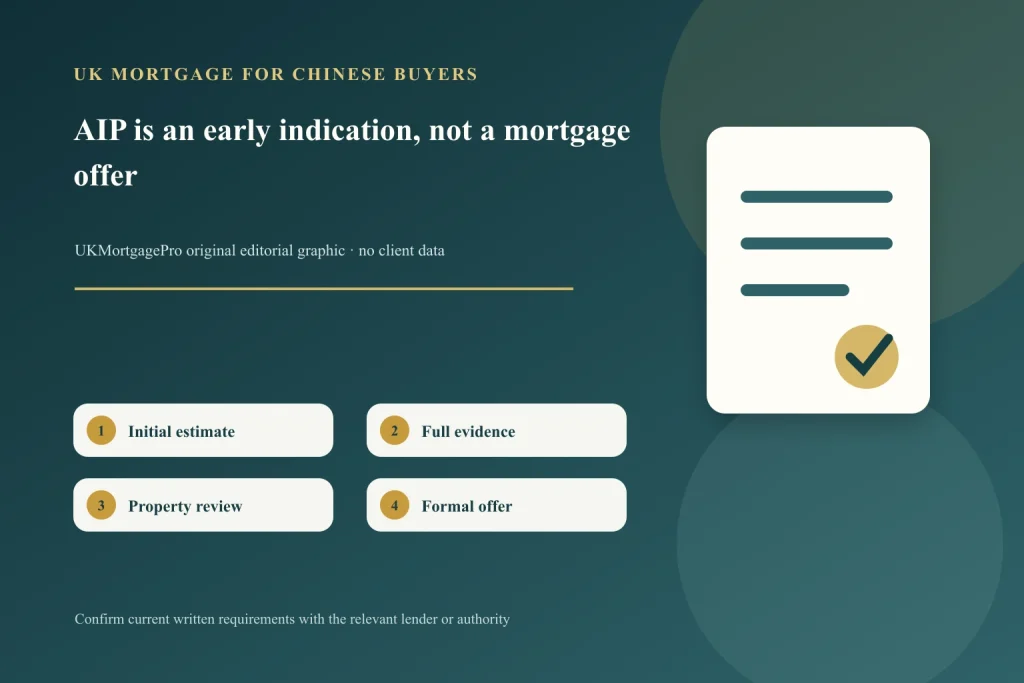
For a Chinese buyer planning a UK property purchase, an Agreement in Principle can be useful for budgeting and early conversations with an estate agent. It is not, however, a final mortgage approval. Treating the two documents as interchangeable can create avoidable risk when an offer is made, funds are transferred or legal deadlines are agreed.
MoneyHelper describes a mortgage in principle—also called an Agreement in Principle or Decision in Principle—as a written estimate of how much a provider might be willing to lend after an initial review of income and, in some cases, a credit file. Its guide says the document is not an official mortgage offer and is commonly valid for a limited period. Lender practices, including the type of credit search and validity period, can differ.
The early-stage information normally includes identity details, address history, income, monthly expenditure and deposit size. A buyer whose income, savings or current address is outside the UK should make sure the information is consistent across translated documents, bank statements and any explanation of currency or fund transfers. An AIP based on incomplete or simplified information should not be used as proof that the full evidence has been accepted.
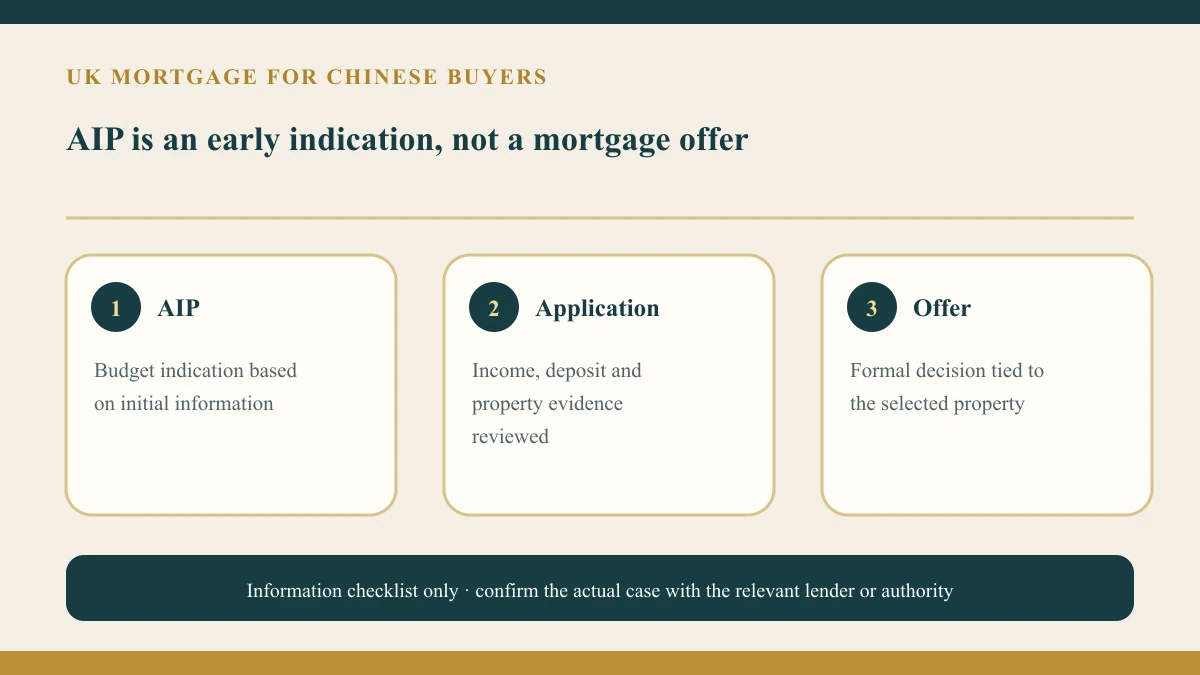
A formal mortgage offer comes later, after a full application and assessment of both the borrower and the property. Even where income appears acceptable, the provider can still decline or change the case if the property valuation, construction, tenure or other security details do not meet its requirements. Changes in employment, income, debt, deposit source or purchase price may also require the application to be reviewed again.
For an overseas buyer, the timeline should therefore keep three separate checkpoints: an initial borrowing estimate, a fully evidenced application, and the formal offer tied to the selected property. The conveyancer’s legal work and the lender’s valuation run on their own tracks. No one should commit to exchange of contracts merely because an AIP exists.
Before relying on the document, ask which information was checked, whether the search was soft or hard, how long the decision remains valid, and what changes must be reported. Also confirm whether the proposed applicant residence, income currency and property use fall within the provider’s current criteria. These questions are more useful than treating the headline amount as guaranteed borrowing capacity.
An AIP can still be a valuable planning tool. Used correctly, it helps define a provisional budget and identifies which evidence needs work before a full submission. The safe interpretation is simple: it is an early indication, not a promise to lend and not permission to skip legal, valuation or source-of-funds checks.
资料来源与适用边界
- MoneyHelper mortgage in principle guide(2026-09-28复核)
This article is an information checklist, not a mortgage offer or approval. Current criteria and evidence requirements must be confirmed for the actual application.
继续了解与咨询
Related pages: UK mortgages、non-resident UK mortgages. Use the consultation page to organise questions; acknowledgement of an enquiry is not mortgage approval.